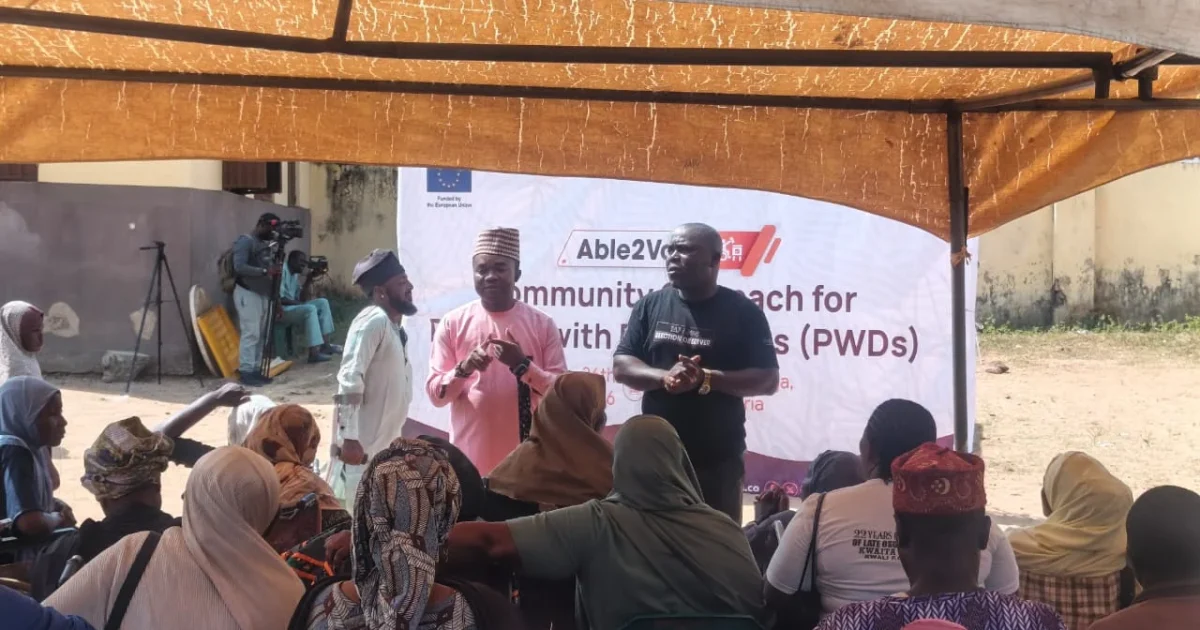
Persons with disabilities in the Federal Capital Territory have lamented difficulties accessing polling units during elections.
This is as they urged the Independent National Electoral Commission and security agencies to address the challenges ahead of the 2027 general elections.
Speaking at a Voter Education Campaign organised by TAF Africa in Abuja on Thursday, the leader of Persons Living with Special Needs in the FCT, Yakubu Shekolo, said poor accessibility, inadequate protection and difficulties navigating polling centres had discouraged some of them from exercising their voting rights.
He said persons with disabilities, particularly wheelchair users, often struggled to gain access to polling units and were sometimes pushed aside while attempting to cast their votes.
“You see a person in a wheelchair struggling just to see how to have access to vote. And by the time you struggle, they push you; you struggle, they push you.
“You know, we get tired of everything. You just give up and say, after all, my vote is not counted,” he said.
He urged electoral stakeholders to provide adequate security, protection and accessible polling facilities to enable persons with disabilities to participate fully in the 2027 elections.
He expressed hope that the sensitisation programme would encourage more persons with disabilities to participate in the electoral process, stressing that they had the constitutional right to vote and be voted for.
Earlier, the Programme Manager of TAF Africa, Andrew Adaji, said the sensitisation exercise was part of TAF Africa’s Able2Vote voter education campaign aimed at preparing persons with disabilities for the forthcoming elections.
Adaji said the campaign covered voter registration, access to Permanent Voter Cards, accessible voting arrangements, ballot secrecy, peaceful participation and ways to identify and counter electoral misinformation.
He said the organisation had conducted similar exercises across the country and was concluding its engagements in the FCT, with activities held in Kuje, Nyanya, Karu, Gwagwalada and other communities.
According to him, increased voter participation among persons with disabilities during previous off-cycle elections was partly attributable to sensitisation efforts and accessibility measures introduced by INEC.
He listed Braille ballot papers, paper guides and magnifying glasses among the assistive devices provided by the commission to improve electoral participation.
Adaji also disclosed that TAF Africa had engaged the police and the Nigeria Security and Civil Defence Corps over challenges faced by persons with disabilities during elections, particularly mobility difficulties and election-related violence.
He said the organisation was also discussing with INEC and the Sign Language Interpreters Association of Nigeria the possibility of engaging sign language interpreters as ad hoc staff at polling units where deaf voters were present.
Also speaking, the Secretary to the Emir of Persons with Disabilities in the FCT, Muhammad Dantani, urged political parties and candidates to prioritise the welfare of persons with disabilities rather than seeking their support through financial inducements.
“We don’t elect parties; we elect people,” Dantani said, urging persons with disabilities to assess candidates based on their willingness and capacity to represent their interests.
He also called for the provision of ramps and other accessibility facilities in markets, hospitals and banks, saying such infrastructure would enable persons with disabilities to access essential services and live with dignity.
