- As ADC crisis, zoning complicate talks
By Myke Uzendu
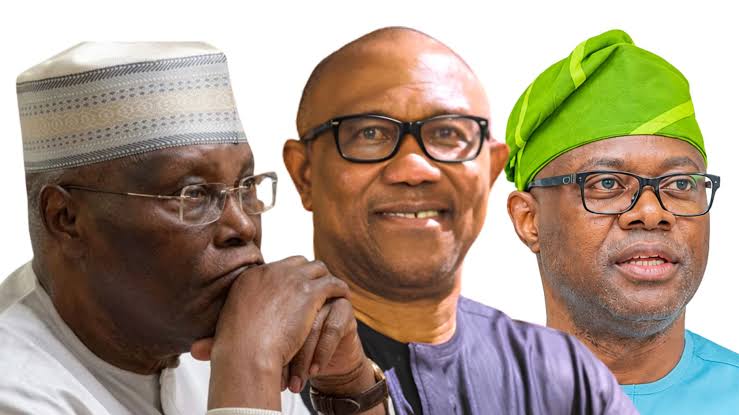
The battle for a common opposition presidential candidate ahead of the 2027 general elections is expected to dominate today’s (Monday) opposition summit in Abuja, with former Vice-President Atiku Abubakar, former Anambra State Governor Peter Obi and Oyo State Governor Seyi Makinde facing competing political interests, regional considerations and party-specific challenges.
The November 30 summit, convened under the Coalition for Democracy championed by a stalwart of African Democratic Congress (ADC) Salihu Lukman will bring together six opposition parties and factions, including the African Democratic Congress (ADC), Nigeria Democratic Congress (NDC), Allied Peoples Movement (APM), Peoples Redemption Party (PRP), Social Democratic Party (SDP) and a faction of the Peoples Democratic Party (PDP).
Although the coalition is expected to adopt three agreements on democratic renewal, opposition cooperation and national reforms, the question of who should emerge as a common presidential candidate remains unresolved.
The negotiations have become particularly complicated by the Federal High Court judgment affecting the David Mark-led leadership of the ADC, the debate over regional power rotation and the competing ambitions of the leading opposition figures.
ADC judgment puts Atiku’s ambition under pressure
For Atiku, the legal uncertainty surrounding the ADC has introduced another complication into his presidential ambition.
A Federal High Court judgment delivered on November 5 by Justice Peter Lifu invalidated the emergence of the David Mark-led leadership and decisions taken by the disputed national officers, including the process that produced Atiku as the party’s presidential candidate.
The ruling followed a suit challenging the process through which Mark and other opposition figures assumed control of the party.
Although the ADC has appealed the judgment, the legal dispute has raised questions about the legitimacy of the party’s leadership and the validity of decisions taken under it.
The development is significant because the ADC had become a major rallying platform for opposition politicians seeking to consolidate their political structures ahead of the 2027 elections.
Atiku’s spokesman, Paul Ibe, however, dismissed suggestions that the judgment would affect the former vice-president’s participation in the election.
“The election cannot be affected in any shape or form,” Ibe told journalists, insisting that Atiku and other candidates who emerged through the disputed primaries would remain on the ballot.
He also disclosed that the campaign had appealed the judgment and filed an application for a stay of execution.
Atiku himself has maintained that he is not withdrawing from the presidential race.
In a statement through his Director of Strategic Communication, Phrank Shaibu, the former vice-president declared: “I do not need anyone to step down for me, and I am stepping down for no one.”
The ADC crisis nevertheless presents a challenge for the opposition coalition, particularly as its proposed political arrangement depends on the ability of participating parties to demonstrate internal stability and legal certainty.
Obi’s grassroots appeal and zoning argument
While Atiku battles the implications of the ADC leadership dispute, Obi’s growing support among opposition constituencies and the debate over regional power rotation have introduced another dimension into the negotiations.
A coalition of support groups that previously backed Atiku recently endorsed the Obi-Kwankwaso presidential ticket of the NDC, citing regional power rotation and the need for opposition unity.
The endorsement followed consultations among political support groups concerned about presenting a common opposition platform against the ruling APC.
The development has strengthened the argument among some opposition stakeholders that the presidential ticket should reflect the principle of power rotation between the North and South.
Obi, a former governor of Anambra State, is also associated with a grassroots political movement that gained considerable national attention during the 2023 presidential election.
His supporters point to his appeal among young voters, urban professionals and grassroots political networks as important considerations in the search for an opposition candidate capable of mobilising support across different constituencies.
His running mate, Rabiu Musa Kwankwaso, also brings an established political following, particularly in Kano and parts of northern Nigeria.
The endorsement by the Atiku Support Groups Initiative, however, did not translate into Atiku’s withdrawal from the contest.
Atiku’s campaign subsequently rejected the suggestion that the former vice-president had abandoned his ambition.
Makinde’s APM platform faces national reach questions
Makinde’s involvement in the negotiations presents another dimension to the search for a common candidate.
The Oyo State governor, who is contesting under the APM has indicated his willingness to participate in an opposition arrangement but insists that the eventual choice must be based on objective considerations rather than personal preferences.
In a November 13 interview, Makinde said the aspirants’ manifestos, previous performance and public sentiment should guide the selection process.
“Not only that I’m open, we’re actively discussing this,” he said when asked about the possibility of working with Atiku.
He added: “We have manifestos now; we have certain things in that manifesto. We will sit down; we have maybe historical performance. We also have the sentiment of the people. All of those things will come together and arrive at a decision.”
However, Makinde’s presidential ambition is being pursued through a party whose national electoral profile and organisational reach are considerably less established than those of the major political platforms.
This raises questions about the extent to which the party can independently sustain a nationwide presidential campaign and the political concessions it may have to make in a broader opposition arrangement.
Sowore kicks against coalition arrangement as Duke supports move.
Another feature of the emerging opposition arrangement is the absence of Omoyele Sowore and his African Action Congress (AAC) from the six-party coalition.
Sowore, who has consistently advocated a different approach to opposition politics, was not listed among the participating parties in the November 30 summit.
His absence means that the coalition does not represent the entire spectrum of opposition political interests ahead of the 2027 elections.
Former Cross River State Governor Donald Duke, however, is expected at the summit as the presidential candidate of the Peoples Redemption Party.
Duke is among the other presidential contenders expected to participate in the discussions, alongside Atiku, Obi, Makinde and the SDP candidate, Adewole Adebayo.
Coalition rules out predetermined consensus announcement
Despite expectations that the summit could produce a breakthrough in the negotiations, the head of the Coalition Secretariat, Salihu Mohammed Lukman, has cautioned against assuming that the participating candidates will announce their withdrawal in favour of a consensus candidate.
Speaking ahead of the meeting, Lukman expressed confidence that all invited delegates would attend.
Asked whether the summit’s programme required presidential candidates to announce their withdrawal in favour of one candidate, he said: “Why don’t you wait? We can’t determine what they are going to talk about there? We don’t dictate to them.”
The coalition is expected to adopt three foundational documents: the National Covenant for Democratic Renewal, the Framework for Opposition Unity and the National Reform Programme.
A source within the coalition secretariat described the National Covenant as a common commitment to democratic principles.
“The National Covenant for Democratic Renewal is the coalition’s common promise. In it, each party acknowledges that it has at some time fallen short of what Nigerians deserve, and commits afresh to principles every democrat can share—power that comes only from the people, the rule of law, and nation before party,” the source said.
Several Nigerians have expressed optimism that President Bola Tinubu can only be kicked out of office if the opposition parties particularly Peter Obi and Atiku Abubakar, can present a common front.
Commenting on the development, Dr. Charles Awuzie, a Cyber Security expert and social media commentator, wrote on his Facebook page on Saturday “If Obi, Atiku, Kwankwanso, Amaechi and Seyi succeed in their Monday meeting and decide to join forces, there will be No amount of Rigging that will stop them from winning the elections. This is simple mathematics”.
