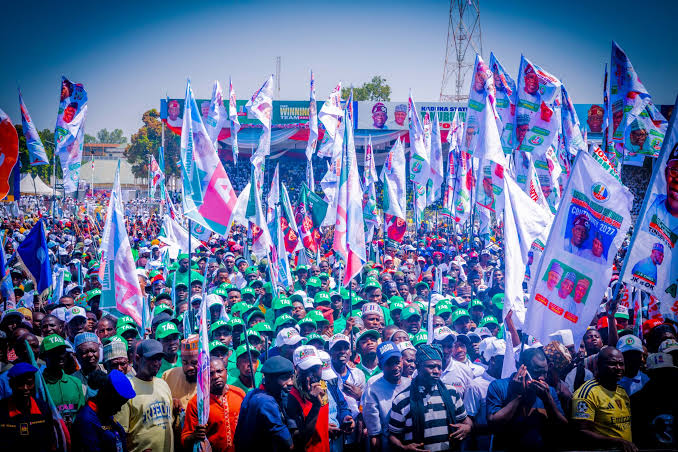
As Nigeria inches towards the 2027 presidential election, mammoth campaign rallies and impressive political gatherings are raising questions about whether crowd strength can translate into actual votes, ADEMU IDAKWO reports.
As Nigeria inches closer to the 2027 presidential election, the growing emphasis on campaign rallies, massive political gatherings and public displays of support is once again raising questions about what truly determines electoral success in the country’s increasingly competitive political environment.
President Bola Ahmed Tinubu of the All Progressives Congress (APC), former Vice President Atiku Abubakar of the African Democratic Congress (ADC) and former Anambra State Governor Peter Obi of the Nigeria Democratic Congress (NDC) are among the major political figures seeking the presidency. Their political engagements, mobilisation efforts and growing campaign activities have brought the question of crowd strength and actual electoral support to the centre of the emerging contest.
Across the country, political rallies are becoming important platforms for demonstrating popularity, consolidating political alliances and projecting the strength of individual candidates and their parties. From the North-West to the South-East, South-South, South-West and North-Central, political gatherings are expected to provide a glimpse into the mood of the electorate and the capacity of political parties to mobilise supporters.
However, beneath the excitement, colourful banners, political chants and enthusiastic supporters lies a fundamental question; Do mammoth rally crowds necessarily translate into actual votes?
For the three political figures, the road to the presidency involves considerably more than attracting thousands of supporters to campaign venues. It requires building sustainable political structures, maintaining voter commitment, strengthening grassroots networks and persuading Nigerians across different geopolitical zones to support their candidacies at the polling units.
The distinction between crowd mobilisation and electoral victory has remained one of the most interesting features of Nigeria’s political experience, particularly since the return to democratic rule in 1999.
The 2023 Election: A Lesson In Crowd Politics
Perhaps one of the clearest illustrations of the difference between political enthusiasm and electoral performance can be found in the 2023 presidential election.
The election witnessed intense political mobilisation, with Tinubu, Atiku and Obi attracting considerable attention across the country. Their campaigns generated strong public interest, particularly among young people, political organisations, social media communities and supporters of different political movements.
When the results were eventually declared by the Independent National Electoral Commission (INEC), Tinubu emerged as the winner with 8,794,726 votes, while Atiku polled 6,984,520 votes and Obi secured 6,101,533 votes.
Another important dimension was voter participation. Out of 93,469,008 registered voters, only about 25 million were accredited to vote, highlighting the gap between the number of registered voters and actual electoral participation.
The figures provide an important context for the 2027 contest. While political parties may attract impressive crowds, their ability to convince supporters to participate in the electoral process remains a different challenge.
Tinubu And The Advantage Of Incumbency
For Tinubu and the APC, the 2027 election presents the challenge of defending an existing political mandate while seeking to sustain the coalition that brought the president to power in 2023.
The ruling party has the advantage of an established nationwide political structure, elected officials, state governors, legislators and other political stakeholders who can contribute to campaign mobilisation.
However, the APC’s mobilisation efforts will take place against the background of public debate over the economy, insecurity, unemployment, the cost of living and the impact of government policies.
Consequently, the size of APC rallies may not, on its own, provide a complete picture of how Nigerians intend to vote.
For the president, the challenge is not simply to assemble supporters but to demonstrate that his administration’s policies and programmes have addressed the concerns of ordinary Nigerians.
Atiku And The Opposition Mobilisation Challenge
For Atiku, the ADC presidential candidate, the emerging political contest provides another opportunity to consolidate opposition support and build a nationwide coalition capable of challenging the ruling party.
The former vice president has remained a prominent figure in opposition politics, with experience in presidential contests and an extensive network of political associates across the country.
However, the challenge before him extends beyond attracting large gatherings at political events.
The ADC must demonstrate that it can build an effective national campaign structure, strengthen its presence at ward and polling-unit levels and maintain a united political front.
Opposition mobilisation also faces the challenge of reconciling different political interests, personalities and ambitions within a broad coalition.
For Atiku, the critical question is whether the enthusiasm generated by his political engagements can be converted into a sustained electoral network that reaches voters beyond the major cities.
Peter Obi And The Challenge Of Sustaining Political Enthusiasm
Obi’s political influence became particularly visible during the 2023 presidential election, when his Labour Party candidacy attracted considerable support, especially among young Nigerians.
His campaign generated significant enthusiasm among supporters who identified with his message of political change, accountability and economic reform.
The emergence of the Obidient movement also demonstrated how social media platforms and organised citizen participation could influence political conversations and campaign activities.
However, his transition to the NDC ahead of the 2027 election introduces another dimension to his political mobilisation.
Beyond maintaining the enthusiasm of his existing supporters, Obi faces the task of expanding his political appeal, strengthening the new party’s structures and establishing a wider electoral presence.
The challenge is particularly important because enthusiasm among supporters does not automatically guarantee the organisational capacity required for a nationwide presidential campaign.
The Crowd Versus The Ballot
Reacting to the growing emphasis on mammoth political rallies, the national vice president of the Nigerian Political Science Association (NPSA), Professor Murtala Muhammad, said the crowds witnessed at the rallies of Tinubu, Atiku, Obi and other presidential contenders should be interpreted cautiously.
According to him, although such gatherings demonstrate political visibility, mobilisation capacity and public enthusiasm, they are not necessarily reliable indicators of electoral strength.
He said there was a fundamental distinction between crowd mobilisation and electoral conversion, explaining that financial inducements, rent-a-crowd arrangements, social pressure, private voting preferences, candidate credibility, economic conditions, ethnicity, religion and regional calculations could create a significant disconnect between rally attendance and actual votes.
“A citizen may enthusiastically attend one party’s rally and exercise an entirely different choice at the polling booth,” he said.
Muhammad said each of the major contenders faced distinct electoral challenges, noting that Tinubu had the advantage of incumbency and the APC’s nationwide structures, but public perceptions of his administration’s performance on inflation, insecurity and the cost of living remained significant.
He said Atiku must contend with opposition fragmentation, party cohesion and organisational challenges, while Obi needed to translate his considerable public enthusiasm into sustainable grassroots structures and broader national coalitions.
Citing the 2023 presidential election, Muhammad said the approximately 26.7 per cent voter turnout, despite over 93 million registered voters, demonstrated the gap between political mobilisation and actual electoral participation.
“Ultimately, the rally ground measures political spectacle, but the polling booth measures electoral preference. A thousand applauding voices do not necessarily translate into a thousand votes; the true currency of democracy is the number and geographical spread of valid votes secured,” he said.
On what Nigerians should consider when assessing the presidential contenders, the political scientist urged voters to look beyond mammoth crowds, social media popularity and celebrity endorsements.
He identified functional grassroots structures, organisational discipline, national spread, sustainable coalition-building, committed voters and public trust as important considerations.
He added that Tinubu must contend with public perceptions of his administration’s economic and governance record, while Atiku faces questions of opposition cohesion and political trust. Obi, he said, must demonstrate that his popular appeal can translate into durable party structures and broader national acceptance.
Muhammad further stressed the importance of party cohesion, internal democracy, electoral preparedness and the credibility of the electoral process.
He called for issue-based political competition and institutional political development, arguing that the 2027 election should not be a contest over who could assemble the largest crowd, but rather over who could build the strongest political institutions, articulate a credible national vision and earn the confidence of the electorate.
Social Media Popularity And The Voter Factor
Another important factor shaping the 2027 presidential election is the growing influence of social media in political mobilisation.
Facebook, X, Instagram, TikTok and other digital platforms have become important channels through which candidates communicate their messages, engage supporters and respond to political developments.
Campaign videos, photographs of rallies, trending hashtags and online discussions can create enormous public attention around political candidates.
However, digital popularity comes with its own limitations. The number of followers, likes, comments and shares associated with a candidate does not necessarily represent the number of registered voters who will eventually cast their ballots.
The challenge before political parties is therefore to connect online mobilisation with physical engagement, voter education and participation in the electoral process.
The Importance Of Grassroots Political Structures
Beyond the excitement of presidential rallies, the strength of political parties at the grassroots remains a critical component of electoral mobilisation.
The presidential election is not determined by the number of supporters who gather at a stadium or public square. It is determined by votes cast by eligible voters across thousands of polling units nationwide.
This makes ward executives, local government party leaders, community mobilisers, women’s organisations, youth groups and other grassroots political actors important components of the electoral process.
Political parties must establish effective communication channels between their national leadership and supporters in different communities.
A party that organises impressive rallies but fails to maintain an effective grassroots network could struggle to sustain the momentum generated by such gatherings.
Regional Support And The National Electoral Equation
Nigeria’s political diversity also makes regional mobilisation an important consideration for presidential candidates.
The six geopolitical zones have different political interests, historical experiences, economic concerns and expectations from the federal government.
Consequently, a candidate’s popularity in one region cannot automatically be interpreted as evidence of nationwide acceptance.
The ability to build political alliances across geopolitical zones, engage influential community leaders and communicate policies that address the concerns of different groups will remain important.
For Tinubu, Atiku and Obi, the challenge is to maintain their existing political support while reaching voters in areas where their parties may have limited influence.
CISLAC: Nigerians Must Look Beyond Rally Crowds
Also reacting, the Civil Society Legislative Advocacy Centre (CISLAC) said large crowds at political rallies might demonstrate enthusiasm but should not be regarded as proof of electoral strength.
The organisation, through its Executive Director, Auwal Musa Rafsanjani, said rally attendance could be influenced by political mobilisation, financial inducements, curiosity or genuine loyalty.
CISLAC maintained that Nigeria’s electoral experience had shown that political excitement did not automatically translate into votes, stressing that a crowded stadium was not a polling unit and social media popularity was not an election result.
The organisation urged Nigerians to assess Tinubu, Atiku and Obi through verifiable public support, genuine voter commitment and nationwide electoral mobilisation rather than the size of their political gatherings.
It identified grassroots party structures, polling-unit presence, regional spread, voter commitment, credible policy alternatives and public trust as important factors voters should examine.
According to CISLAC, the incumbent must account for his administration’s performance against electoral promises, while opposition contenders must demonstrate credible records, realistic alternatives and the capacity to deliver.
It also called on all contenders to present measurable commitments on insecurity, corruption, poverty, unemployment and economic hardship, backed by practical implementation plans.
CISLAC urged Nigerians to move from political spectatorship to informed electoral participation, advising voters to interrogate candidates’ track records, reject vote-buying and political inducements, scrutinise campaign financing and insist on issue-based political engagement.
It added that campaign promises should be documented and used to assess government performance beyond election day.
“CISLAC’s position is clear: Elections must be a contest of ideas, integrity, competence and public accountability — not a competition over manufactured popularity, political propaganda or social media noise,” Rafsanjani said.
He stressed that Nigerians must recognise that their votes were instruments of democratic accountability and not commodities for political bargaining.
“The true measure of leadership is not the crowd a politician attracts, but the public trust they earn and the results they deliver,” he added.
NDC Chieftain Disagrees, Says Crowds Will Translate Into Votes
However, expressing a divergent opinion, a chieftain of the Nigerian Democratic Congress (NDC), Samson Ibe, who resides in Nyanya, Abuja, said the large crowds witnessed at political rallies in previous elections could translate into votes this time, particularly because of what he described as Nigerians’ growing desire for change.
Ibe, who spoke with LEADERSHIP Weekend in Abuja, said Nigerians were tired of the ruling APC administration, which he alleged had brought untold hardship to the people.
He argued that the political atmosphere ahead of the 2027 election was different and that the enthusiasm being demonstrated by supporters of opposition candidates should not be dismissed.
“If you think the large turnout for Peter Obi or Atiku Abubakar would not translate into votes, then wait until January 16, 2027, and the results will give you the answer.
“Nigerians are tired, and the need for change is what we are all desirous of,” he claimed.
His position contrasts with the cautious assessment of the political scientist and CISLAC, both of whom maintained that rally attendance alone could not establish the actual electoral strength of candidates.
Beyond The Rallies: The Real Political Test
Ultimately, the 2027 presidential election will be about much more than who can assemble the largest crowd, attract the loudest applause or generate the most attention on social media.
For the APC, the challenge is to defend its political mandate and demonstrate that its nationwide structure can translate into continued voter support.
For the ADC, it is to build a united opposition platform, strengthen its grassroots presence and turn its mobilisation efforts into electoral participation.
For the NDC, the task is to sustain Obi’s political following while building the organisational capacity required for a nationwide presidential contest.
Beyond these three political camps, the election will also test the ability of other political parties to establish their relevance and present credible alternatives to Nigerians.
The 2027 presidential contest will therefore test the relationship between political popularity, party organisation, public trust and actual voter participation.
Mammoth crowds may dominate campaign headlines, but the votes recorded at polling units will determine the outcome.
In the final analysis, the difference between political popularity and electoral success may well be found in what happens after the rallies are over, the campaign vehicles have departed and supporters have returned to their communities.
For the presidential contenders, attracting the crowd is only the beginning. Winning the confidence and votes of Nigerians is the bigger challenge.
We’ve got the edge. Get real-time reports, breaking scoops, and exclusive angles delivered straight to your phone. Don’t settle for stale news. Join LEADERSHIP NEWS on WhatsApp for 24/7 updates →
