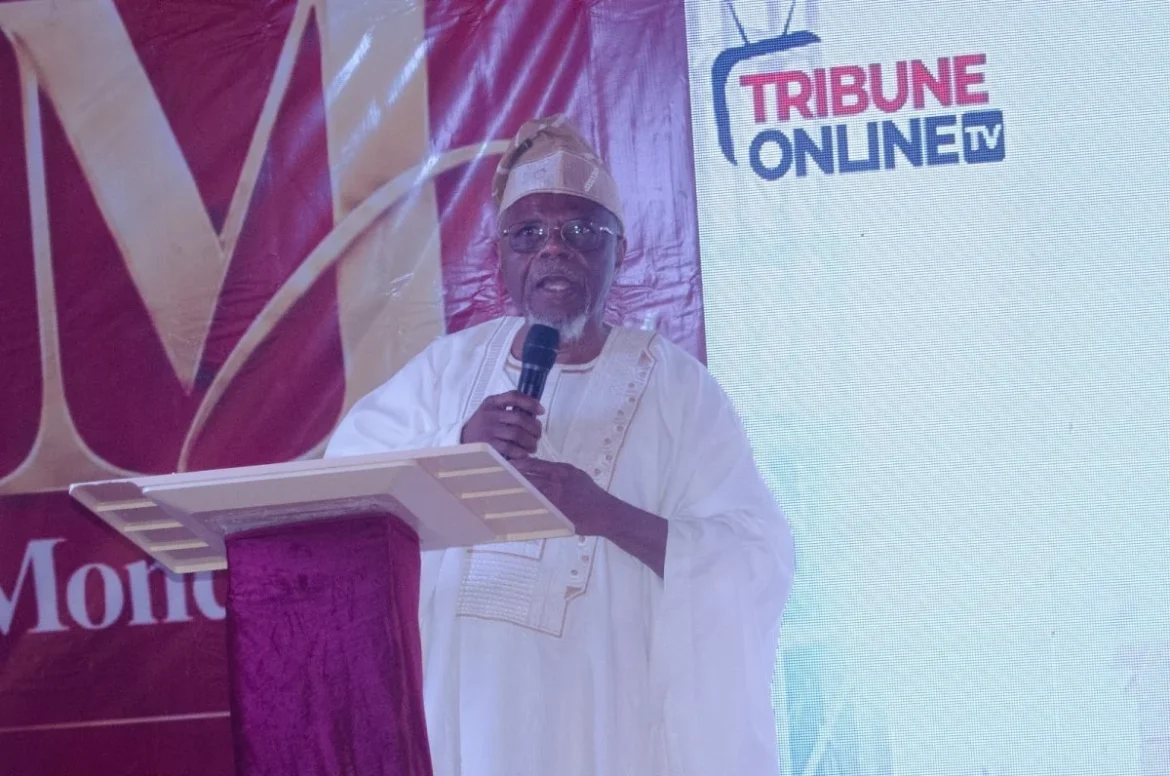
Renowned historian and scholar, Prof Toyin Falola, has described the writings of Columnist and Editor, Saturday Tribune, Dr. Lasisi Olagunju as an important record of Nigeria’s contemporary history, saying his books preserve valuable accounts of the country’s political, social and cultural developments.
Falola spoke at the launch of ‘Sitting on Two Hundred Needles’ and eight other books authored by Olagunju, held at the International Conference Centre (ICC), University of Ibadan.
He said Olagunju’s writings raised important questions about leadership, accountability and the country’s political institutions.
“What does leadership mean in a society that remains insecure and in economic distress?” Falola asked, citing one of the difficult questions raised in Olagunju’s writings.
He also questioned why politics in Nigeria was often disconnected from tangible results and what would become of a country whose institutions no longer catered to the needs of its citizens.
ALSO READ: I won’t contest again after 2027 but will participate, Makinde clarifies
The historian noted that Olagunju’s criticisms had not severed his relationship with the people he wrote about, describing this as a mark of a great writer.
“You can also see the assembly of very distinguished people who are here, some of whom he must have criticised in the past. And that is a mark of a great writer,” he said.
Falola described Olagunju as a public intellectual who had taken journalism beyond reporting to engage with national questions.
“The fact that you’re a journalist does not mean you cannot write as a public intellectual,” he said.
He commended Olagunju’s use of Yoruba traditions, language and oral history to explain political and social issues, noting that his humour also helped readers participate in important discussions about knowledge and culture.
“He stresses issues around accountability and he deploys extensively Yoruba traditions, and his funny lines allow us to participate in an important discussion concerning language, knowledge, and culture,” Falola said.
He urged scholars and students of literature, history, political science and nationalism to study Olagunju’s works, describing them as useful materials for understanding Nigeria.
Falola particularly praised the journalist for compiling his newspaper columns into books, saying the publications would serve as an archive for researchers and future generations.
“In his books, he preserves historical materials, so getting a copy of these books, you are keeping an archive, not just of his writings, but of our contemporary history,” he said.
He added that the publication of the books addressed the need to preserve Nigeria’s intellectual history.
“By presenting his books today, it deals with the major issue of the preservation of Nigeria’s intellectual history. For those of you who do intellectual history, these books now become almost like a bible for you to use,” Falola said.
According to him, the books would make it easier for researchers to access Olagunju’s writings rather than search through archives for individual newspaper columns.
“If he doesn’t put the books together, you have to go and hire an archivist who will be digging them out, as I’ve done in searching for some of his writings,” he said.
Falola said Olagunju’s works captured changes in Nigeria and provided materials for understanding the country’s public life.
He also acknowledged Ibadan’s connection to the journalist, saying the city could claim him despite his not being from Oyo State.
WATCH TOP VIDEOS FROM NIGERIAN TRIBUNE TV