Follow THISDAYLIVE on GoogleAdd us as a preferred source to see more of our stories in Google
At the Sir Ahmadu Bello Memorial Foundation in Kaduna on Thursday, November 26, 2026, Arewa Think Tank, an influential northern socio-political organisation, endorsed President Bola Tinubu for re-election and Governor Uba Sani for a second term. It also backed candidates of the All Progressives Congress (APC) in the 2027 elections. The timing was significant. With some commentators speaking of Tinubu’s support in Northern Nigeria as though its decline were settled, an organisation with established grassroots ties publicly made the case for his return. Its endorsement brings into the debate voices and considerations that forecasts of his political fortunes too readily overlook.
“Today’s occasion represents more than a political endorsement,” said Muhammad Alhaji Yakubu, the organisation’s convener. “It is a declaration of confidence, a demonstration of collective responsibility and an expression of our determination to contribute meaningfully to the political and developmental future of our country.” The gathering, themed “Our Diversity, Our Strength,” brought together traditional and religious leaders, scholars, civil society groups, farmers, traders, artisans, transport operators, young people and representatives of persons with disabilities. That breadth mattered because public policy is experienced differently in a university, a mechanic’s workshop and a rural market.
Yakubu said the organisation had spent three years cultivating relationships across the region. “We did not wake up yesterday and decide to assemble people for a political event,” he said. Some participants brought their Permanent Voter Cards. The group pledged to mobilise through its grassroots networks and proposed enlisting 3,000 communicators, 1,000 each in the North-West, North-East and North-Central zones. The credibility of that effort will depend on how closely it adheres to the standard Yakubu set for public discussion, which he said should be guided by “facts, verifiable information and constructive criticism.”
Arewa Think Tank’s case for Tinubu drew in part on federal investments whose wider significance becomes clearer when viewed together. Yakubu cited the Abuja–Kaduna–Kano highway, railway development between Kaduna and Kano, the rail corridor through Kaduna, Kano, Jigawa and Katsina towards Maradi, and investment in the Nigerian Defence Academy in Kaduna. Better transport links can give farmers access to more buyers, make deliveries more predictable for manufacturers and expand trade across the border. “Transportation infrastructure is not simply about moving people,” Yakubu said. “It is about moving economic opportunities.”
The convener also commended President Tinubu’s commitment to reviving the Ajaokuta Steel Mill. “A functional Ajaokuta will create opportunities for industries, strengthen our manufacturing capacity and reduce dependence on imported steel products,” he said. The group considered the steel project as part of a broader assessment of federal investment in infrastructure, education, healthcare and economic development.
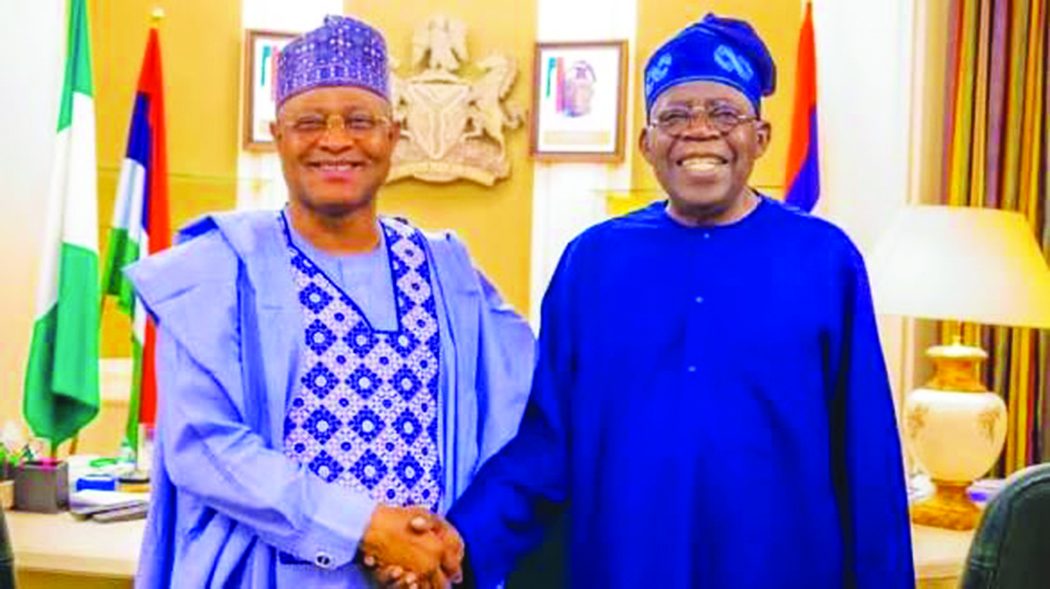
Governor Sani thanked the leadership and members of Arewa Think Tank for endorsing both him and the president. He urged northern voters to turn out in large numbers in 2027 to renew Tinubu’s mandate and set out the record on which he based that appeal. He said the president had approved ₦600 billion for the Abuja–Kaduna–Kano highway and that federal road projects covered roughly 1,300 kilometres in the North-West, 1,400 in the North-East and 1,200 in North-Central Nigeria. Of these, he said, 348 kilometres had been completed in the North-West, nearly 400 in the North-East and about 355 in North-Central Nigeria. In Kaduna, he pointed to the ongoing ₦178 billion Mando–Birnin Gwari road, the Zaria–Soba–Pambegua road project and the planned Kaduna light rail.
Governor Sani also cited the Nigerian Education Loan Fund (NELFUND) and the Federal Technical and Vocational Education and Training programme. He said Northern Nigerians accounted for 63 per cent of the beneficiaries of the student loan scheme and 70 per cent of those benefiting from the vocational programme. The figures framed his challenge to presidential contenders who have previously held public office. Each, he argued, should explain what they did with the authority they exercised. The same standard applies to incumbents and challengers alike. Voters deserve to know who gained access to education and training, where commitments were honoured and which communities are still waiting.
In Kaduna, the case for Sani’s endorsement begins with the recovery of ordinary life in communities battered by insecurity. When he took office in May 2023, families in parts of the state had abandoned their farms and had to weigh the risks of journeys to school or market. Through the Kaduna Peace Model, his administration brought security agencies into sustained dialogue with traditional rulers, religious leaders and community representatives. The reopening of markets in Birnin Gwari and Kidandan gave traders and farmers a chance to rebuild their livelihoods. In his address, Sani said farmers across the state had reclaimed more than 500,000 hectares previously abandoned because of insecurity.
The administration has supported that recovery with agricultural investment. Sani said the sector’s budget allocation rose from N1.48 billion in 2023 to more than N100 billion in 2026. More than 69,000 smallholder farmers received improved inputs and access to mechanisation, while more than 900 truckloads of fertiliser reached 200,000 farmers across the state’s 23 local government areas. Partnerships helped deploy more than 200 tractors, and over 100,000 farmers were enrolled in crop insurance. The Rural Access and Agricultural Marketing Project and the Special Agro-Industrial Processing Zones address another set of needs. Farmers need dependable roads to reach buyers and nearby facilities to process what they grow. Across Kaduna, the administration has initiated about 160 road projects covering approximately 1,335 kilometres, with many of those roads already in use.
In healthcare, the governor said Kaduna had upgraded 255 primary healthcare centres to Level 2, begun establishing a primary care centre of excellence in each local government area and renovated 19 general hospitals. The administration also commissioned the 300-bed Bola Ahmed Tinubu Specialist Hospital in Kaduna and the 140-bed Renewed Hope Specialist Hospital in Zaria. Its initial recruitment of 1,800 health workers, deployment of 17 ambulances, establishment of 120 neonatal care corners and installation of three oxygen plants addressed the staffing and equipment on which patients depend. As Sani put it, “The day-to-day test is whether a patient can count on those services when it matters.”
Education offers further grounds for confidence. By its first anniversary, the administration had commissioned 62 new secondary schools, extending access in rural and underserved communities. It raised the retirement age for teachers from 60 to 65 to retain experienced staff and supplied 3,750 computers to 150 schools, alongside training for teachers. A 50 per cent tuition cut at state-owned tertiary institutions eased the financial burden on families. In August, 4,050 artisans graduated from the Kaduna State Institute of Vocational Training and Skills Development, each receiving N200,000 in start-up support. For a newly trained artisan, the ability to buy tools or take on a first order can determine whether a qualification becomes a livelihood.
Running through Governor Sani’s record is a commitment to making public services accessible across Kaduna’s religious, ethnic and political divides. His response to the endorsement reflected that approach.
“Citizens will form their own judgement about the course we have taken. We owe them an honest account of what we have achieved, where progress remains uneven and what we intend to do with the mandate we seek.”
He urged APC candidates to explain what they could achieve in the offices they seek, listen to constituents even when the questions are difficult and respect the electorate’s judgement.
Arewa Think Tank’s endorsement makes visible a constituency that predictions of Tinubu’s decline in the North too often overlook. It also places a responsibility on both leaders. Tinubu must translate federal investment and economic reform into gains households and businesses can feel. Sani must consolidate Kaduna’s progress and extend it to communities still waiting for dependable services and lasting security. Voters will weigh those responsibilities against what they know from daily life. They know the value of a road that carries a harvest to market, a clinic that has oxygen when a child needs it and a school that can stay open through the term. Sani described the freedom to make such ordinary plans as “one of the most meaningful things peace and good government can give a people.” How widely that freedom is shared will be the enduring measure of the leadership Arewa Think Tank has chosen to endorse.
Ahmed, a freelance journalist resides in Kawo, Kaduna.
