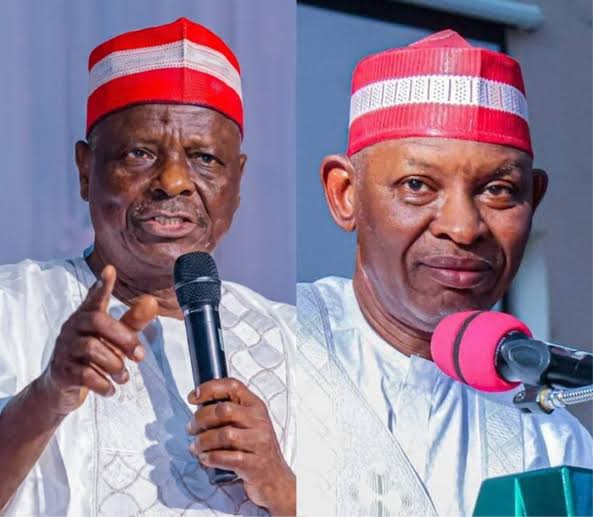
The vice-presidential candidate of the National Democratic Congress (NDC), Rabiu Kwankwaso, has accused Kano State Governor Abba Yusuf of allegedly using the Economic and Financial Crimes Commission (EFCC) to tarnish his reputation ahead of the 2027 general elections.
Kwankwaso alleged that Yusuf, his former political ally, had personally petitioned the anti-graft agency to investigate him, but resorted to using a civil society organisation to pressure the commission after failing to secure its cooperation.
The former Kano governor made the allegations in a statement on Friday, expressing concern over what he described as an attempt by the state governor to deploy government institutions for political vendetta.
He said the alleged plot was aimed at dragging him and members of his family into public controversy and destroying the reputation he had built over nearly five decades.
“It is on this basis that I believe he is determined to drag me and my family into public controversy by leveraging reputable government agencies, particularly the EFCC, in an attempt to tarnish the public image I have spent nearly fifty years building,” he said.
Kwankwaso claimed that Yusuf personally submitted a formal request to the EFCC several months ago, asking the commission to investigate him.
“We believe that some months ago the Governor personally submitted a formal request to the EFCC seeking to come after me. After failing to compel the Commission, owing to its institutional integrity and established procedures, he resorted to a little-known body called the Society for Anti-Corruption and Good Governance Initiative,” he stated.
He further alleged that the organisation was subsequently mobilised to stage a protest at the EFCC headquarters in Abuja to pressure the commission into acting on the petition.
The former governor also accused Yusuf and some members of his cabinet of orchestrating a media campaign against him through selective leaks of information to portray him negatively.
“We further believe that the Governor and certain members of his cabinet continue to deploy the media to advance this campaign against my reputation. Information is being selectively leaked and amplified through the media and other public platforms to portray the situation in the worst possible light,” he added.
Linking the alleged moves to the 2027 elections, Kwankwaso said they were designed to distract his political camp, undermine its credibility and weaken its electoral chances.
“Coming as it does within the context of the electioneering season, these actions appear calculated to distract attention from substantive issues, undermine our credibility, and weaken our capacity to contest and win elections in 2027,” he said.
Kwankwaso also alleged that the political dispute extended to his camp’s governorship candidate in Kano State, Aminu Abdussalam, whom he claimed the governor was attempting to prevent from appearing on the ballot.
He accused Yusuf of allegedly seeking to influence institutions, including the Independent National Electoral Commission (INEC) and the judiciary, to frustrate Abdussalam’s ambition to contest the 2027 governorship election.
“This constitutes a further attempt by the Governor to manipulate elements within reputable institutions, INEC and the judiciary, to prevent the publication of our candidate’s name and ultimately bar him from contesting the 2027 general election, so that the Governor may run unopposed,” he alleged.
However, the Kano State Government dismissed the allegations, insisting that Yusuf had no involvement in Kwankwaso’s dealings with the EFCC.
In a statement signed by the state Commissioner for Information and Internal Affairs, Sunusi Bature Dawakin Tofa, the government said Kwankwaso had engagements with the anti-graft agency before the emergence of the current administration.
It described the former governor’s claims as misleading and politically motivated, maintaining that the state government had no involvement in the internal crisis and court cases involving the NDC.
Meanwhile, Kwankwaso commended the EFCC for what he described as its professional handling of two previous invitations extended to him during his years in public service.
He insisted that his record in public office remained clean, citing his previous positions as governor of Kano State, Minister of Defence, senator and Deputy Speaker of the House of Representatives.
“I thank God that more than eleven years after leaving the Kano State Government, having served two full terms as Governor spanning eight years, in addition to seventeen years in the civil service … I have maintained a clean record,” he said.
He also cautioned serving and aspiring public office holders against using public institutions to settle political scores.
“Public office is transient; those who live in glass houses should be careful about throwing stones,” he warned.
The NDC chieftain further urged political actors to respect the independence of public institutions, warning that attempts to compromise their operations could undermine public confidence in them.
The allegations followed a protest organised by the Society for Anti-Corruption and Good Governance Initiative (SACGGI) at the EFCC headquarters in Abuja on November 25.
During the protest, the organisation submitted a petition urging the commission to investigate properties allegedly linked to Kwankwaso in Abuja, Kano and Nasarawa states.
The group called for an investigation into the sources of funds used to acquire the properties, a review of his asset declarations and a lifestyle audit.
The EFCC’s Chief of Staff, Michael Nzekwe, who received the petition, assured the protesters that it would be considered on its merits and handled professionally.
The latest development comes amid an escalating political feud between Kwankwaso and Yusuf, who was previously his political protégé and served under him as personal assistant, principal private secretary and commissioner.
Yusuf won the 2023 Kano governorship election with Kwankwaso’s backing on the platform of the New Nigeria Peoples Party (NNPP) before defecting to the All Progressives Congress (APC) in January 2026, a move that further widened the rift between the former political allies.
We’ve got the edge. Get real-time reports, breaking scoops, and exclusive angles delivered straight to your phone. Don’t settle for stale news. Join LEADERSHIP NEWS on WhatsApp for 24/7 updates →
